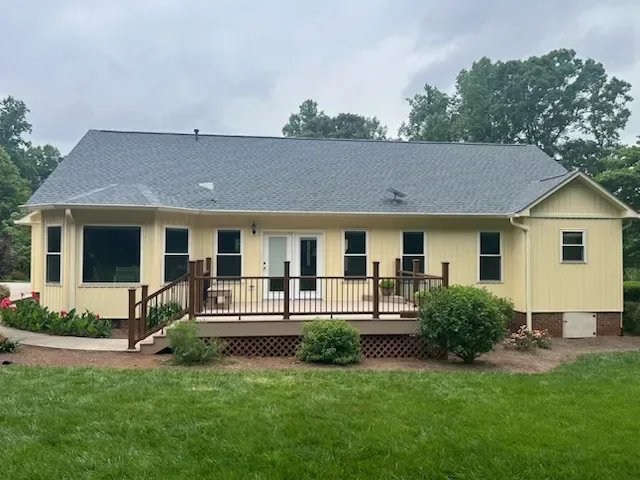
Deck Builders of Maryville builds custom wood and composite decks in Plainfield and throughout Blount County — including the low-profile ground-level decks that look simplest and are quietly the most demanding to build properly.
No pressure and no obligation. We respond the same day, confirm your address is in our Blount County service area, and set up a time to come look at the space.
New builds in wood and composite, custom multi-level layouts, covered decks and pergolas, railing systems, and repairs to decks worth saving.
Pressure-treated pine and cedar — the most affordable route to real outdoor space.
Learn more →Low-maintenance decking that resists fading, mold, insects and splintering.
Learn more →Multi-level layouts, picture-frame borders, built-in seating and integrated lighting.
Learn more →Design, permitting, footings, framing and finish — handled end to end.
Learn more →Roofs and pergolas that keep the space usable through heat and afternoon storms.
Learn more →Joist and post replacement, re-decking, ledger corrections, code upgrades.
Learn more →Plainfield is a residential community in the Maryville area of Blount County. Where the land here sits closer to the valley floor rather than climbing toward the national park boundary, a low deck that flows straight out into the yard is often the better design than an elevated one — and it's the job people most consistently underestimate.
A ground-level deck has almost no room underneath, and that single constraint drives everything. Limited depth for conventional framing. Limited access to install and later inspect it. And, critically, limited airflow. A deck built tight to damp ground with no ventilation traps humid air against its own joists and fails from underneath while the surface still looks new.
In a county that takes well above the national average in annual rainfall, that is not a theoretical risk. It's the standard failure mode for low decks that were treated as simple platforms.
Everything that makes a low deck last is in the preparation. Site grading before framing so water moves away rather than pooling. A ground barrier and a real drainage plan. Framing members rated and treated for ground-contact conditions rather than standard above-grade material. And deliberate ventilation at the perimeter instead of sealed skirting that turns the underside into a humid box. Built that way, a low deck lasts as long as anything else we put up.
The upside is significant. A walking surface under roughly 30 inches above the grade below it generally falls beneath the threshold that triggers guard requirements — which means no railing, an uninterrupted surface, and a deck that reads as an extension of the lawn rather than a structure bolted to the house. On the right lot that's a better result and a cheaper one. Because the exact threshold and how it's measured depend on your jurisdiction and your grade, we confirm it for your specific address rather than assuming.
The most common build here is the low deck off a back door with a step or two down to the lawn and no railing — simple to look at, and entirely dependent on the drainage and ventilation work underneath it.
The second is replacing a low deck that rotted from below within a decade, which is almost always a ventilation problem rather than a material one.
Whether you're on flatter ground closer to the valley floor, out toward the US-411 corridor, or in among the Maryville neighbourhoods, we'll come measure your Plainfield project and give you an honest written quote at no cost.
Deck Builders of Maryville is a our Maryville deck team working throughout Blount County. If you're not certain your address falls inside our service area, send it through the form and we'll confirm either way.
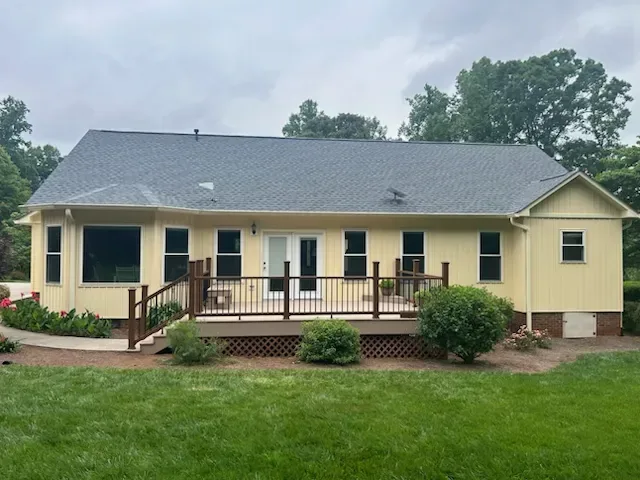
Generally guards are required once a walking surface sits more than about 30 inches above the grade below it, so many low-profile decks fall under that threshold and can be built without railing — and that open edge is a large part of the appeal. Because the exact threshold and the way it's measured depend on your jurisdiction and your grade, we confirm it for your specific address rather than assuming it.
Trapped moisture, not the material. A deck built tight to damp ground with no ventilation holds humid air against its own framing, and the structure fails from underneath while the deck boards still look fine. Site preparation and grading, a ground barrier, correctly rated ground-contact framing and deliberate airflow at the perimeter are what prevent it. Built that way a low deck lasts as long as an elevated one.
Decks go up year-round here and the off-season has real advantages. Spring and early summer are when everyone calls, so lead times stretch. Autumn and winter generally mean a faster start, and the work itself is unaffected — footings and framing go in fine in cold weather. The one thing that shifts is staining or sealing a new wood deck, which wants dry conditions and moderate temperatures.
Ledger attachment and flashing. The ledger fastens the deck to the house and carries an enormous share of the load. Fastened with the wrong hardware or left unflashed, it both risks structural failure and channels water into the band board of the house itself — turning a deck problem into a house problem. It's also invisible once the deck is finished, which is exactly why it gets skipped.
Footings need to bear below the local frost line so seasonal freeze-thaw cycling can't lift them, and they need to be sized for the load each post actually carries. Both the required depth and the inspection process are set by the jurisdiction governing your address, so we confirm the current requirement for your location rather than working from a rule of thumb. The footing inspection is part of the permitted process.
Yes. Cut-offs, fasteners and packaging are removed, and we run a magnet sweep for dropped screws and nails before we leave — which matters more than it sounds if you have kids, pets or a lawnmower. We walk the finished deck with you, confirm you're satisfied, and go over care for the material you chose.
Deck Builders of Maryville works across Blount County, Tennessee — from Maryville and Alcoa out to the communities along the edge of the Great Smoky Mountains. Select any community for details on deck building in that area.